
People often notice people from East Asian and Southeast Asian regions of the world have slimmer body types and very low obesity rates compared to Western populations. This leads to a common question: why are most Asian people so slim?
It is important to establish from the start this is no longer a universal truth—recently Asian countries are seeing rising obesity rates—but historically populations in Japan, China, Korea, Vietnam, Thailand, and Singapore have maintained lower average body weight for thousands of years.
The explanation isn’t genetics alone. Instead, multiple nutritional, mindset, metabolic, and lifestyle factors work together to influence the body type across these populations.
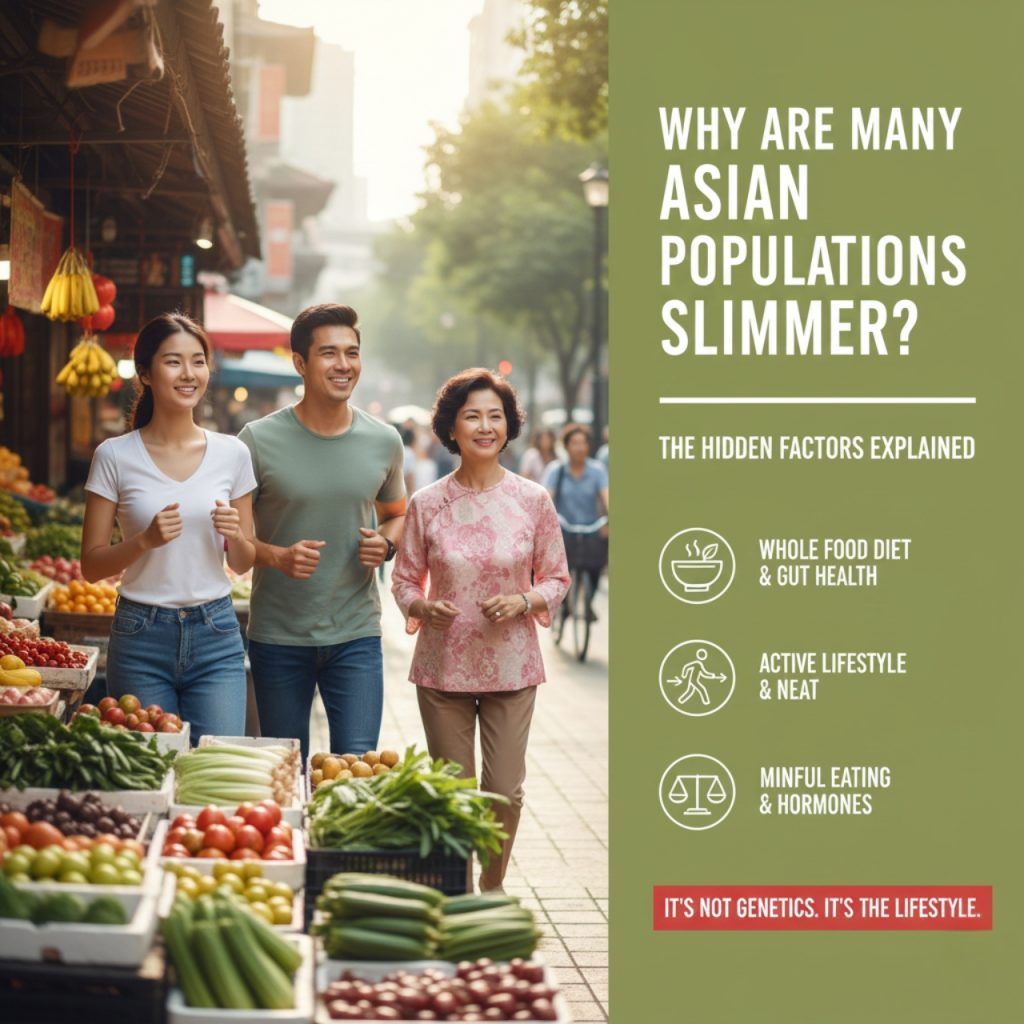
Dietary Patterns and Their Metabolic Impact
One of the most consistently documented reasons for lower obesity rates in many Asian countries is their eating habits. Traditional Asian diets are built around whole foods: fruits and vegetables, legumes, fermented foods, herbal broths, lean proteins, and carbohydrate intake from brown rice or noodles. Unlike the highly processed, sugar-heavy Western diet, the typical Asian eating pattern has a naturally lower glycemic load (lower blood sugar levels) and higher nutrient density.
A significant portion of calories in traditional Asian meals comes from vegetables, fruits, rice, beans, legumes and other fiber-rich ingredients. These foods slow emptying through the gut, support gut microbiome diversity, stabilize blood sugar, and reduce overeating. Fiber also improves insulin sensitivity (sugar entering into the blood effectively)—one of the strongest predictors of weight regulation.
Fermented foods such as kimchi, natto, miso, tempeh, and pickled vegetables play a central role in many Asian cuisines. These foods support gut health, reduce inflammation, and improve metabolic activity. A healthy gut microbiome (gut bacteria)has been strongly linked to lower body fat and improved hormonal signaling related to hunger and fullness.
Portion size also differs dramatically. For example, Asian populations typical meals contain significantly smaller or no meat, desserts, or refined snacks found in common Western meals. Eating smaller, balanced meals reduces excess caloric intake without requiring restrictive dieting.
Daily Movement and Low-Intensity Physical Activity
Another essential factor is the lifestyle habits found in Asian countries. Movement is built into daily life, not added as an extracurricular activity. People commonly walk or bike to work, take public transportation, climb stairs, or navigate cities on foot rather than relying heavily on cars.
This habitual low-intensity, high-frequency movement improves metabolic health significantly. Research shows that NEAT (non-exercise activity thermogenesis)—all the calories burned through daily living, not workouts—is one of the strongest predictors of body weight. Many Asian cities naturally promote higher NEAT levels because of forced walking because of the dense urban layouts.
On the other hand, Western lifestyles often involve long periods of sitting, driving, and computer based desk work. Even if someone exercises intensely for 30 minutes, the remaining hours of sedentary time significantly slow metabolism. Asian populations, by contrast, often mount up thousands of additional steps daily without ever “exercising.”
Eating Culture, Timing, and Mindfulness
Medical studies also highlight the impact of eating behavior, not just food composition. In many Asian cultures, meals are eaten slowly, shared with others, and served in multiple small dishes. This naturally encourages mindful eating and reduces binge-style eating so common in western cultures.

On top of all that, heavy breakfasts and light dinners are common. This aligns closely with our body’s natural biological rhythms. Also, eating earlier in the day improves insulin response and fat metabolism, while late-night eating disrupts metabolic hormones like leptin (feeling satisfied hormone) and ghrelin, (hunger hormone).
In contrast, Western populations tend to skip breakfast, snack frequently, and eat their largest meal at night—patterns strongly associated with weight gain and metabolic imbalances.
Genetics: A Small but Meaningful Piece of the Puzzle
Genetics do play a role, but far less than most people assume. Recent research proves genetics contributes 5% to 7% to chronic metabolic disorders and diseases. While certain Asian populations have genetic traits associated with smaller body frames, this does not grant immunity from weight gain. In fact, many Asians have a higher sensitivity to insulin resistance, meaning they may develop metabolic issues at lower body weights.
This is why medical guidelines classify obesity and diabetes risk differently in Asian populations. Their genetic makeup influences fat distribution—often more visceral fat around the organs despite a leaner appearance. So while genetics contribute to overall body type, they do not fully explain differences in obesity rates. Lifestyle factors remain far more influential.
Environmental and Food System Differences
Access to ultra-processed foods in the western populations significantly shapes national obesity rates. In the past, Asian countries had lower consumption of soda, fast food, packaged snacks, and high-sugar desserts. Their food intake was primarily fresh produce and seafood purchased fresh from local markets.
In contrast, Western nations have decades-long exposure to highly processed foods engineered for overconsumption. These foods disrupt hunger hormones, create imbalances in gut bacteria, and promote chronic inflammation—all strong drivers of weight gain.
However, as western lifestyle spreads across the globe, Asian countries have increased fast-food availability—consequently, China, Malaysia, and the Philippines—are experiencing rapid increases in obesity. This shift reinforces the fact that the environment, more than genetics, shapes population-wide body weight.
Lower Chronic Inflammation and Gut Health Differences
Inflammation is a hidden driver of weight gain. Diets high in refined sugar, hydrogenated, highly processed seed oils, and other processed ingredients increase inflammatory markers and disrupt metabolic hormones.
On the flip side, Asian diets, especially traditional ones, are naturally anti-inflammatory due to:
- Regular consumption of ginger, turmeric, garlic, onion, and herbal broths
- Abundant fruits, vegetables, legumes, and fermented foods
- Lower reliance on dairy and processed sugar
These foods support a healthier gut microbiome, and gut health strongly influences weight, appetite, and even cravings. Studies show that people with diverse gut bacteria tend to have lower levels of body fat and better metabolic flexibility.
Asian microbiomes, historically shaped by whole-food diets, protect against obesity—although Westernization is rapidly changing this pattern.
Societal Norms and Body Image Expectations
Health outcomes are strongly influenced by societal behaviors. In many Asian countries, walking, movement, balanced meals, and traditional dietary patterns are everyday habits. Cultural habits reinforce moderation, discipline, and awareness of body health.
In addition, many Asian societies emphasize regular health monitoring—from routine checkups to personal responsibility for weight and fitness. This preventive mindset contrasts with Western medical culture, which is more treatment-focused and less preventive.
Understandingly, body image pressure can sometimes be problematic, but the overall social environment often promotes healthier habits from a young age.
A Holistic Medical View: Why Asian Populations Tend to Be Slimmer?
When we pull all these factors together, lifestyle, and cultural habits, a pattern emerges. It’s not one secret or one genetic advantage—it’s a combination of multiple protective factors:
- Whole-food, high-fiber, anti-inflammatory diets
- Strong gut microbiome support through fermented foods
- Smaller portion sizes and mindful eating
- Active daily lifestyles with built-in movement
- Low to no intake of processed foods
- Earlier meal timing
- Supportive cultural norms around health
This combination creates a healthy environment that naturally resists weight gain. When any of these factors shift—as seen in Asian countries adopting Western eating patterns—obesity rates rise quickly, proving the cause is not inherited, but rather created by behavioral and environmental patterns.
Conclusion
Asian populations appear slimmer not because of genetic traits or cultural myth, but because of a powerful blend of diet, mindset, lifestyle, microbiome health, eating habits, and environmental structure. These factors support strong internal health and well being, reduced inflammation, and healthier blood sugar regulation—key foundations for maintaining a healthy weight.
As modern Asian societies adopt Western dietary patterns, obesity rates are climbing, reinforcing that lifestyle, not nationality, is the true influencer. The takeaway is simple: if we adopt more of the traditional Asian approaches to eating and movement, we can support our own metabolic health, no matter where we live.